All-Season vs. All-Weather vs. Winter Tires: What's the Difference?
Learn how all-season, all-weather and winter tires differ in cold, snow and ice, and where NEXEN TIRE N'PRIZ S, N'BLUE 4Season 2, WINGUARD Sport 2 and WINGUARD winSpike 3 fit your winter.
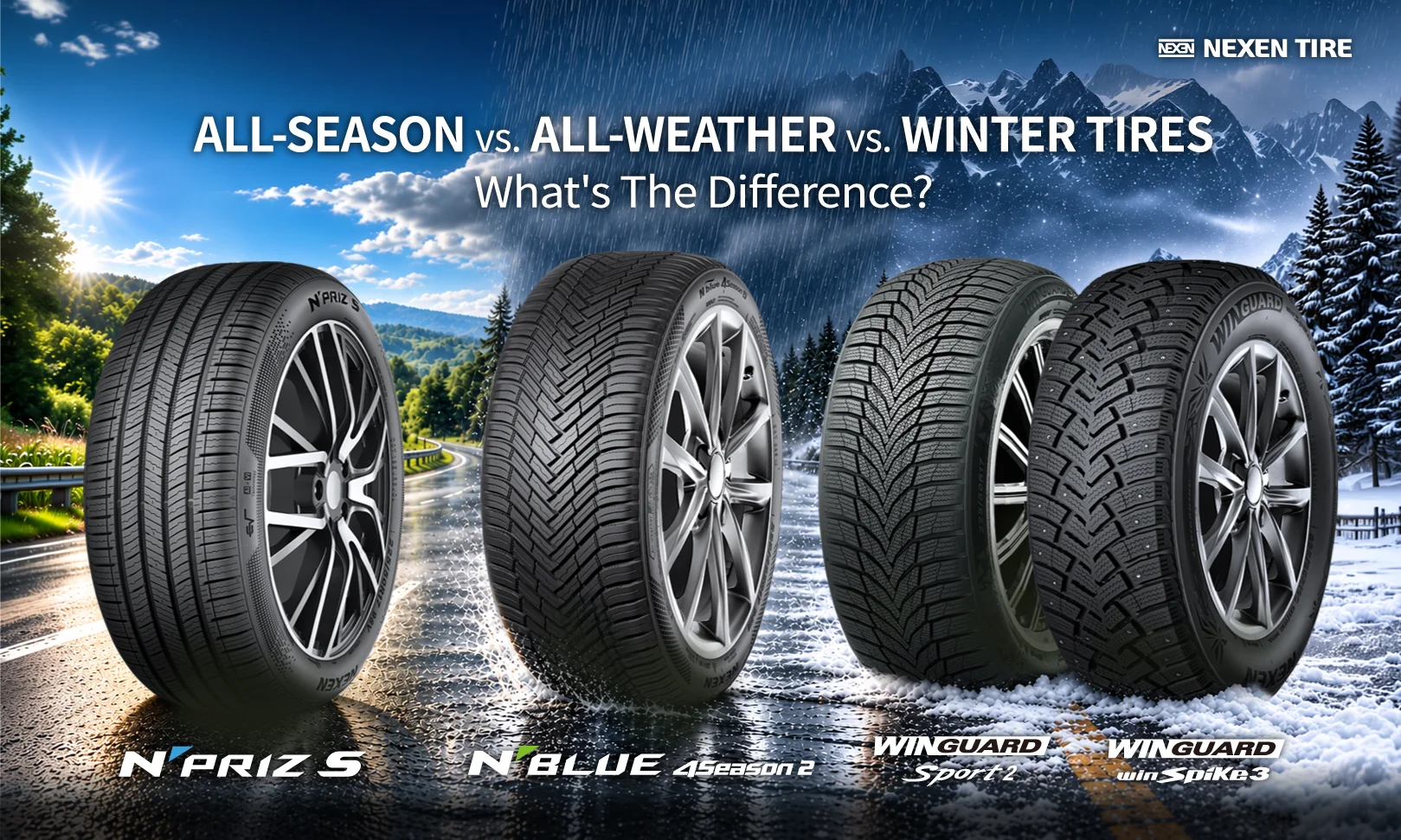
All-season, all-weather and winter tires differ in how they handle cold temperatures, snow and ice. All-season tires are designed for year-round driving on dry and wet roads and in light winter conditions. All-weather tires are also designed for year-round use without seasonal tire changes, while typically carrying the Three-Peak Mountain Snowflake (3PMSF) symbol, indicating that they meet an industry-defined severe-snow traction requirement. Winter tires are designed specifically for cold, snow and ice, and they are fitted as a seasonal set.
The right type depends on how cold your winters get, how often you drive on snow or ice, and whether you want to keep one set of tires on all year. NEXEN TIRE offers all three types in the U.S.: NEXEN TIRE N'PRIZ S is an all-season tire, NEXEN TIRE N'BLUE 4Season 2 is an all-weather tire, and NEXEN TIRE WINGUARD Sport 2 and NEXEN TIRE WINGUARD winSpike 3 are winter tires.
KEY TAKEAWAYS
- All-season tires such as N'PRIZ S are designed for year-round driving on dry and wet roads and in light winter conditions, which suits regions with mild winters.
- All-weather tires such as N'BLUE 4Season 2 combine year-round convenience with 3PMSF severe-snow traction capability, allowing drivers in suitable climates to use one set of tires throughout the year without seasonal tire changes.
- Winter tires such as WINGUARD Sport 2 (studless) and WINGUARD winSpike 3 (studdable) are designed for long, cold winters with frequent snow or ice, and are fitted as a set of four for the season.
What Is the Difference Between All-Season, All-Weather and Winter Tires?
The three types are built for different temperatures and road conditions. The main differences are the conditions each type is designed for, whether it carries the 3PMSF severe-snow symbol, and whether it stays on the vehicle all year or is fitted for winter only.
| Tire type | Designed for | 3PMSF symbol | NEXEN TIRE product |
|---|---|---|---|
| All-season | Dry and wet roads and light winter conditions | Not usually | N'PRIZ S |
| All-weather | Year-round driving without seasonal tire changes, even in conditions requiring enhanced snow traction | Yes | N'BLUE 4Season 2 |
| Winter, studless | Cold temperatures, snow and ice | Yes | WINGUARD Sport 2 |
| Winter, studdable | Cold temperatures, snow and ice, with optional studs for extra grip on ice | Yes | WINGUARD winSpike 3 |
All-season and all-weather tires can stay on the vehicle all year. Winter tires are fitted as a set of four for the winter season.
What Does the 3PMSF Symbol Mean?
The Three-Peak Mountain Snowflake (3PMSF) symbol is a mountain with three peaks and a snowflake inside, marked on the tire's sidewall. It shows that the tire meets a severe-snow traction requirement.
Under the definition published by the U.S. Tire Manufacturers Association (USTMA), a tire qualifies by reaching a snow grip index of at least 1.10 or 1.12, depending on the standard reference test tire used, in the ASTM F1805 snow traction test on medium-packed snow. A qualifying tire can be marked with the mountain snowflake next to its M+S (mud and snow) marking.
The 3PMSF symbol indicates that a tire meets an industry-defined snow traction requirement. It does not independently certify braking or cornering performance on ice, nor does it mean that an all-weather tire performs identically to a dedicated winter tire in every winter condition.
All-Season Tires: Year-Round Driving Where Winters Are Mild
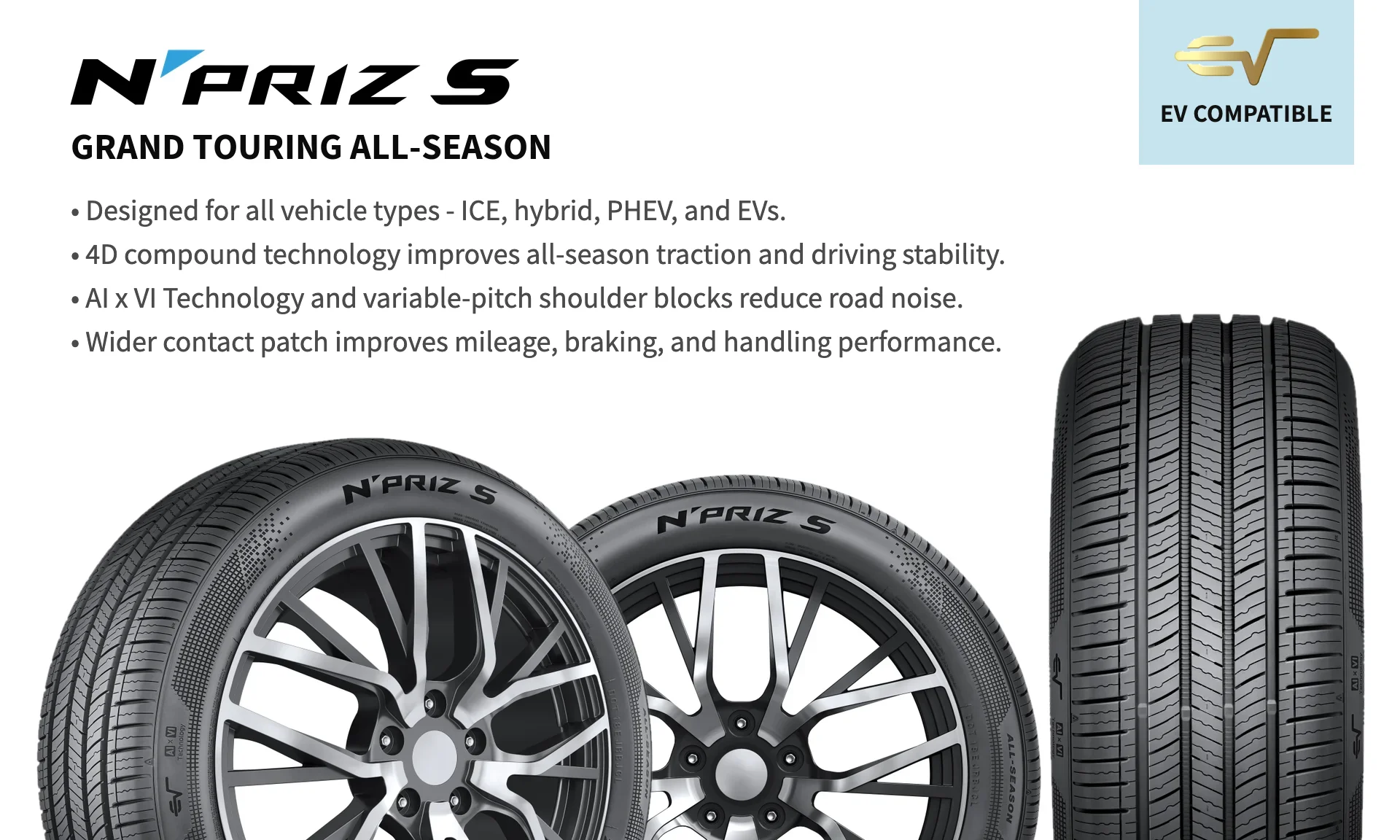
N'PRIZ S is a grand touring all-season tire for sedans, crossovers, hybrids and electric vehicles. It is designed for year-round driving in dry, wet and light winter conditions, and it is designed to balance long tread life, ride comfort and confident handling for drivers who cover high mileage.
N'PRIZ S uses variable-pitch shoulder blocks, developed with AI x VI Technology, that are designed to reduce pattern noise, and 3D sipes designed to support braking and handling on snow and icy roads.
It is available in H, V and W speed ratings, depending on size.
All-season tires suit regions where winters are mild and snow is occasional. The National Highway Traffic Safety Administration (NHTSA) describes all-season tires as able to handle a variety of road conditions, with some mud and snow capability. Where winters bring regular snow or long cold spells, the all-weather and winter tires below are designed for those conditions.
All-Weather Tires: Year-Round Driving Without Seasonal Tire Changes
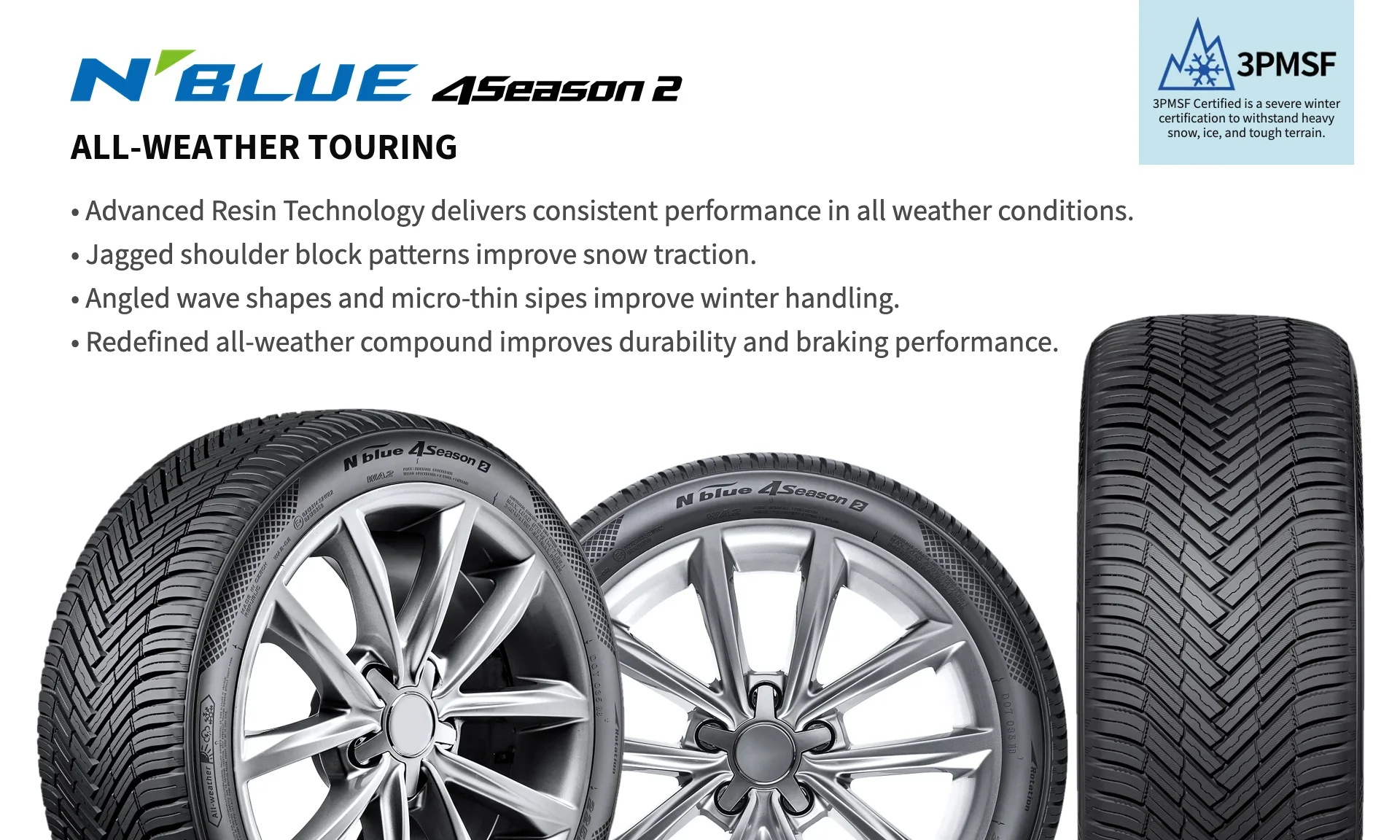
N'BLUE 4Season 2 is a 3PMSF-certified all-weather touring tire. It is designed for year-round driving and meets severe-snow traction requirements while maintaining the ride comfort and tread life expected of a touring tire.
Jagged patterns on both shoulder blocks are designed to improve snow traction, while angled wave-shaped features and micro-thin sipes help expel water and snow to support handling in winter conditions. Its advanced all-weather compound is engineered to maintain flexibility in cold temperatures while providing the stability needed for warmer weather.
For drivers in suitable climates, N'BLUE 4Season 2 offers the convenience of using one set of tires throughout the year, eliminating the need to switch between summer and winter tire sets each season. It suits sedans, crossovers and SUVs, and is available in H, V, W and Y speed ratings, depending on size.
Winter Tires: Built for Cold, Snow and Ice
Winter tires are made for the cold. Their tread compound is designed to stay flexible at low temperatures, and deep tread with dense siping is designed to grip snow, slush and ice. NHTSA notes that winter tires are more effective than all-season tires in deep snow.
Install winter tires on all four wheels. USTMA advises fitting winter tires to all wheel positions to maintain vehicle mobility and control, and never on the front axle alone, including on front-wheel-drive, four-wheel-drive and all-wheel-drive vehicles.
Unlike all-season and all-weather tires, dedicated winter tires are intended for seasonal use. Drivers should switch back to appropriate non-winter tires when winter conditions have passed, following the tire manufacturer's recommendations.
NEXEN TIRE offers two winter tire options in the U.S., each with a different approach to ice.
WINGUARD Sport 2: Performance Studless Winter
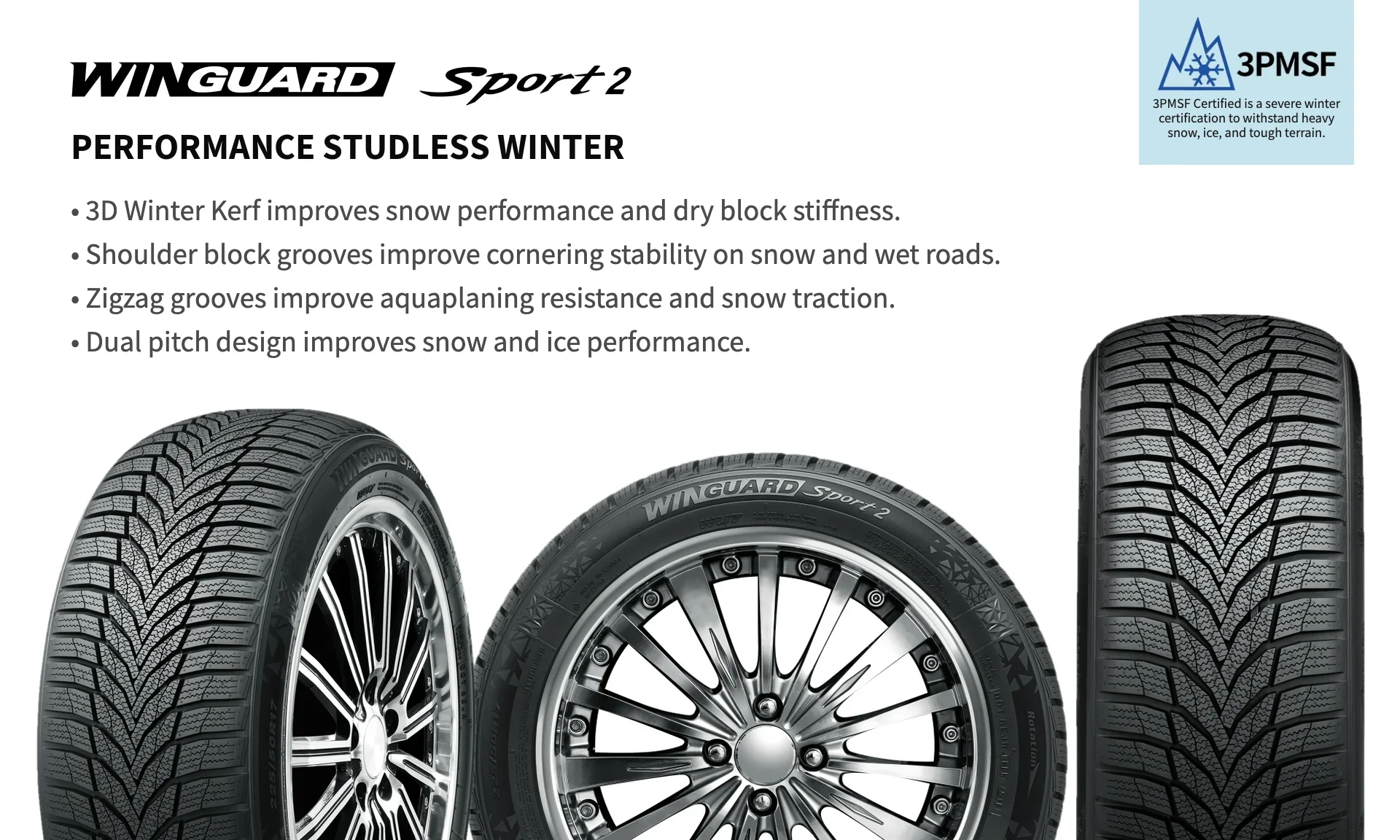
WINGUARD Sport 2 is a performance studless winter tire with 3PMSF certification. Its high-density multi-sipe technology is designed to improve braking grip on ice and snow, and its directional tread pattern is designed to support cornering on snow and dry roads.
It is designed for compatible passenger cars and SUVs, with H, V and W speed ratings depending on size.
WINGUARD winSpike 3: Studdable Winter
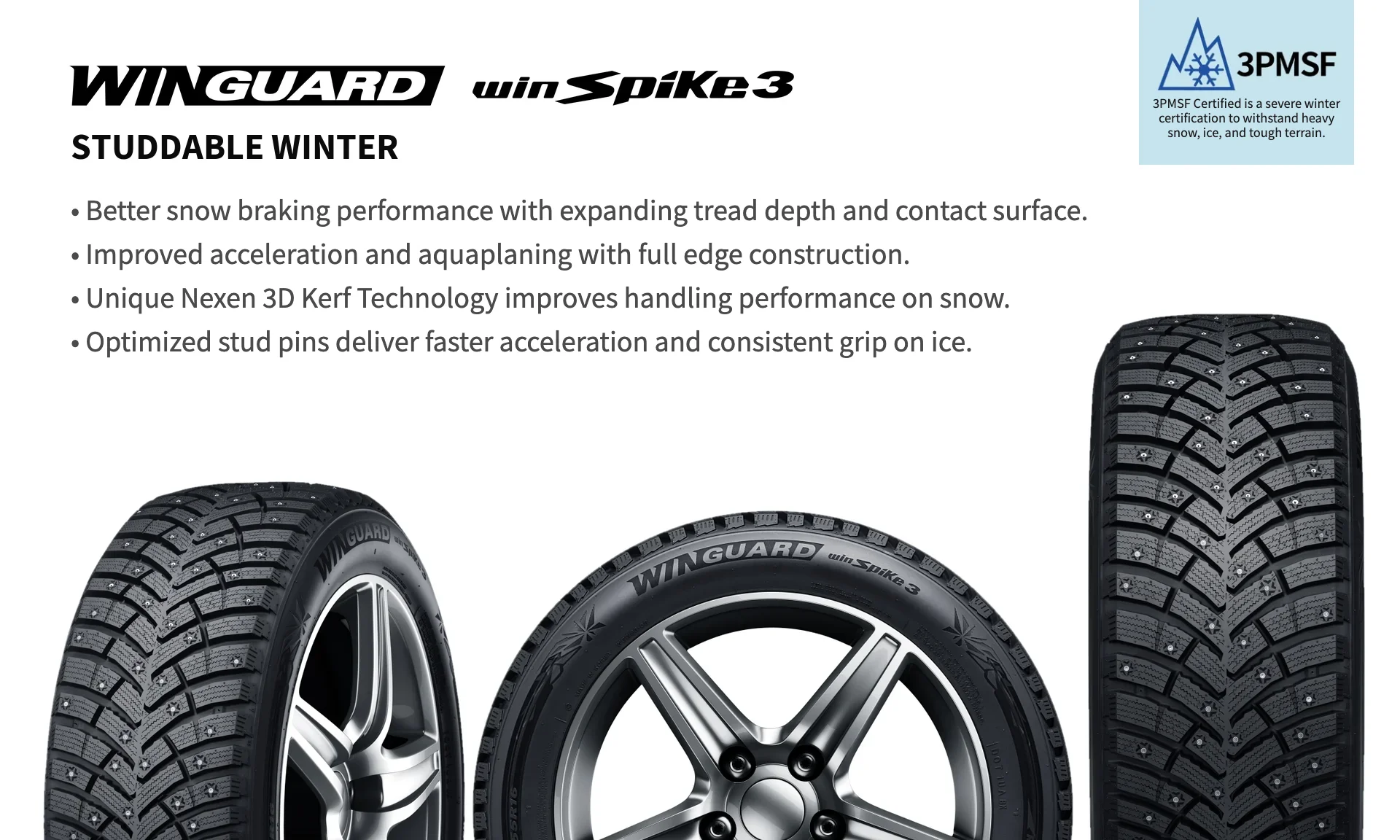
WINGUARD winSpike 3 is a studdable winter tire for sedans, crossovers and SUVs. Its tread features pre-molded stud holes designed to accept compatible metal studs, which can provide additional mechanical grip on ice.
Studs are purchased and installed separately by a qualified tire professional. The tire meets 3PMSF severe-snow traction requirements even without studs installed.
Its 3D Kerf Technology is designed to help the tread blocks maintain consistent contact with the road surface, supporting handling performance on snow.
It is T speed rated on most sizes, with R ratings on select LT sizes.
Studded tires are regulated differently across U.S. states. Some states permit studded tires during specific winter months, others allow them only in certain regions or vehicle types, and a small number prohibit them altogether. Before having studs installed, always verify your local state regulations. The Winspike 3 can still be run without studs where studded tires are prohibited, functioning as a standard studless winter tire.
Which Type Is Right for Where You Drive?
| If your winter is... | Consider | NEXEN TIRE option |
|---|---|---|
| Mild, with occasional light snow | All-season | N'PRIZ S |
| Changeable, with regular snow, and you prefer one tire set year-round | All-weather | N'BLUE 4Season 2 |
| Long, cold, and frequently snowy or slushy | Studless winter | WINGUARD Sport 2 |
| Frequently icy, where studs are legally permitted | Studdable winter, fitted with studs | WINGUARD winSpike 3 |
Whichever type you choose, check the tire placard on the driver's door jamb or your owner's manual for the size, load index, speed rating and inflation pressure specified for your vehicle. Search by vehicle or size with the NEXEN TIRE U.S. Tire Finder, find a nearby dealer with the NEXEN TIRE U.S. Dealer Finder, and have a qualified installer confirm the final fitment.
FAQS
Frequently asked questions
Is an All-Weather Tire the Same as an All-Season Tire?
Not exactly. Both are designed for year-round use without seasonal tire changes, but all-weather tires typically carry the 3PMSF symbol, indicating that they meet an industry-defined severe-snow traction requirement. Conventional all-season tires generally prioritize dry and wet performance with light winter capability. NEXEN TIRE N'BLUE 4Season 2 is a 3PMSF-certified all-weather tire, while N'PRIZ S is a grand touring all-season tire for dry, wet and light winter conditions.
Can I Drive on All-Season Tires in Winter?
Yes, in light winter conditions. NEXEN TIRE N'PRIZ S is designed for dry, wet and light winter driving. Where winters bring regular snow, a 3PMSF-certified all-weather tire such as N'BLUE 4Season 2 or a winter tire such as WINGUARD Sport 2 is designed for those conditions.
Is an M+S Tire the Same as a Winter Tire?
Not necessarily. The M+S (mud and snow) marking on its own does not show that a tire meets the severe-snow traction requirement. Tires that meet it carry the 3PMSF symbol next to the M+S marking. USTMA notes that tires designed for severe snow generally have tread patterns, structure and materials that give better snow performance than tires that meet only its standard snow tire definition. N'BLUE 4Season 2, WINGUARD Sport 2 and WINGUARD winSpike 3 carry the 3PMSF symbol.
Do Winter Tires Need to Be Installed on All Four Wheels?
Yes. USTMA advises fitting winter tires to all wheel positions to maintain vehicle mobility and control, and warns that installing them on the front axle only may cause adverse handling. Fit NEXEN TIRE WINGUARD Sport 2 or WINGUARD winSpike 3 as a matching set of four.
How Do I Check Tread Depth Before Winter?
Look at the wear indicator bars molded into the tread grooves. A tread depth of 2/32 of an inch is a widely used minimum replacement threshold for passenger tires in the U.S., although legal requirements may vary by state and vehicle type. Because tread depth affects resistance to hydroplaning and wet braking, consider replacing tires earlier, before they reach 4/32 of an inch, particularly in wet climates. Tires used regularly on snow may require greater tread depth for adequate traction. Check tread depth before winter, whether you keep N'BLUE 4Season 2 on all year or fit WINGUARD Sport 2 or WINGUARD winSpike 3 for the season, and consult a qualified tire professional if you are unsure about tire condition. For more tread and maintenance checks, see our U.S. Tire Care Guide.
Are Studded Tires Legal in My State?
Studded tire regulations vary across U.S. states. Some states permit studded tires only during specific winter months, while others impose additional restrictions or prohibit their use, subject to certain exceptions. Before installing studs, check your state's current regulations. NEXEN TIRE WINGUARD winSpike 3 can also be used without studs, while still meeting 3PMSF severe-snow traction requirements.
Related reading